Form changes function
Geometry and flow interact in food capture. The conditions determine which structure works.
THE CORAL · STRUCTURE, ADAPTATION, FUNCTION
Structure affects performance. In coral colonies, branching, spacing and orientation influence flow and how food reaches the polyps. Experiments with sea fans demonstrate that orientation changes prey capture.1
This complexity can be measured across scales. Fractal measures describe how coral surfaces fill space. A concrete connection exists in AI: FractalNet explicitly constructs neural networks from recurring, self-similar structures.23
Which structure serves
the task and its conditions?
In corals, evolution and environmentally responsive growth shape functional adaptations. In machine learning, data and learning objectives guide parameter adjustment. Architecture, feedback and constraints matter in both; the mechanisms differ.
My consulting principle follows from this: understand the system, select a suitable architecture and test its effect in practice. Technical complexity must serve a business purpose.
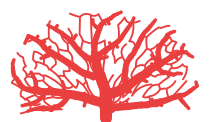
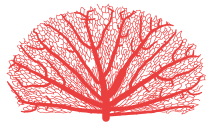
An artistic representation of branching and signals.
Geometry and flow interact in food capture. The conditions determine which structure works.
Fractal measures describe spatial complexity over a defined measurement range.
FractalNet is a documented example of an explicitly self-similar neural architecture.
Fractal measures alone do not prove exact self-similarity. A trained weight matrix or an arbitrary LLM is not automatically fractal. FractalNet is a specific research architecture; the consulting principle above is an interpretation of these findings.